Disclosure: This post may contain affiliate links. If you click and buy, we may earn a commission at no extra cost to you. As an Amazon Associate, we earn from qualifying purchases.
I got a call a few weeks before her wedding from a DIY bride who was in a mild panic. She’d been practicing her centerpieces for months: flowers, containers, the whole setup.
Everything looked beautiful in her Instagram inspiration folder and like a complete disaster on her dining room table. Stems flopping sideways. The whole arrangement shifted every time someone walked past. She was ready to scrap the whole DIY plan and call a florist.
I asked her one question: Are you using floral foam?
She wasn’t. She’d been trying to hold everything in place with just water and willpower.
Floral foam would have fixed every single one of those problems in about thirty seconds. I told her that, walked her through the basics over the phone, and she called me back after the wedding to say the centerpieces were the thing her guests talked about most.
That’s why I always say: if you want to take your floral design skills seriously, whether you’re a DIY bride, a hobbyist, or just starting, you need to get comfortable with foam.
It’s the foundation that holds everything else together. Literally.
And once you understand it, a whole category of arrangements that used to feel impossible suddenly becomes manageable.
There’s also a conversation happening in the industry right now about foam and the environment that I want to be honest about. We’ll get to that. But first, let’s cover the basics.
Don’t Skip the Foundation
Before we get into brands and densities, I want to make one thing clear: a floral arrangement is only as good as the foundation it’s built on.
I’ve seen beautiful, expensive flowers ruined by improperly soaked foam. I’ve seen elegant arrangements ruined because the foam shifted during delivery.
The mechanics aren’t the glamorous part of floral design, but they’re the part that determines whether your arrangement survives the car ride to the venue.
Get this right, and everything else gets easier. Same principle applies to the rest of your kit — I go through my everyday setup in The 8 Floral Design Tools I Use Every Single Day.
Use Oasis®. Don’t Compromise Here.
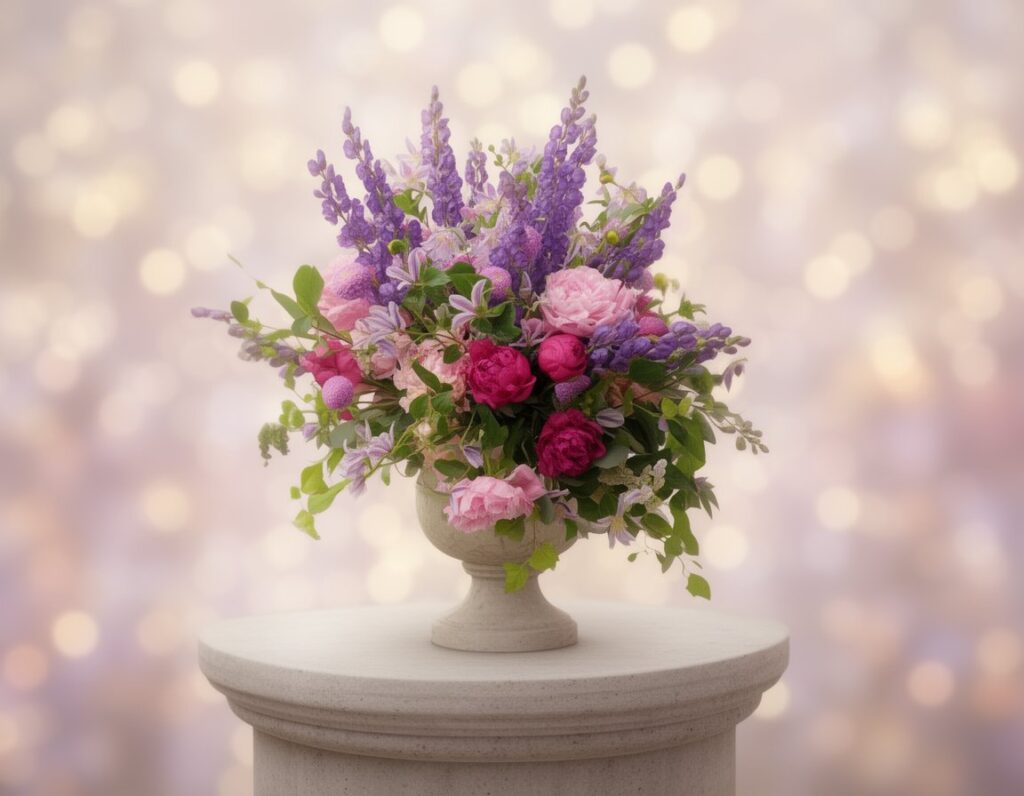
You’ll hear “oasis” used as a generic term for any floral foam. the way people say “Kleenex” for tissues. But the Oasis® brand is actually the gold standard in the flower industry, and in my experience, it’s worth buying the real thing.
I’ve tried the private-label and generic brands in a pinch. And that’s about all they’re good for — a pinch. The difference in performance isn’t dramatic, but when you’re building an arrangement for a client’s wedding or a sympathy tribute, you don’t want to find out your foundation is subpar two hours before delivery.
In my opinion, the money you save on generic foam isn’t worth the risk.
Oasis® Instant Floral Foam on Amazon — this is what we use at the shop for everyday arrangements.
Know Your Densities — They Actually Matter
Oasis® offers several densities, and picking the right one for your flowers makes a real difference. Here’s how I think about it:
Springtime (Light Density)
This is your go-to for soft-stemmed, delicate flowers such as tulips, daffodils, iris, and calla lilies. The lighter density means stems go in without damage. Force a delicate tulip stem into standard-density foam, and you’ll crush it. Use Springtime, and it glides in cleanly.
Standard / Instant Oasis® (Medium Density)
This is the workhorse. Most everyday arrangements, most flower types, most occasions. The Instant version has holes punched through it for faster water absorption, which is why we keep it in stock at the shop. I’ve been using Instant Oasis® for years, and I don’t see a reason to switch.
Instant Oasis® Bricks on Amazon
Deluxe (High Density)
For when you’re working with heavy, woody, or tropical stems like gladiolas, flowering branches, birds of paradise, torch ginger, and heliconia. Standard foam can split or crumble under that kind of pressure. Deluxe holds. I reach for this one for large wedding arrangements, sympathy tributes, and any substantial event piece where I need the mechanics to be bulletproof.
If you’re ever unsure which density to use, ask yourself: how sturdy is the stem I’m inserting? That usually gives you the answer.
Shapes: Cut Your Own or Buy Pre-Made
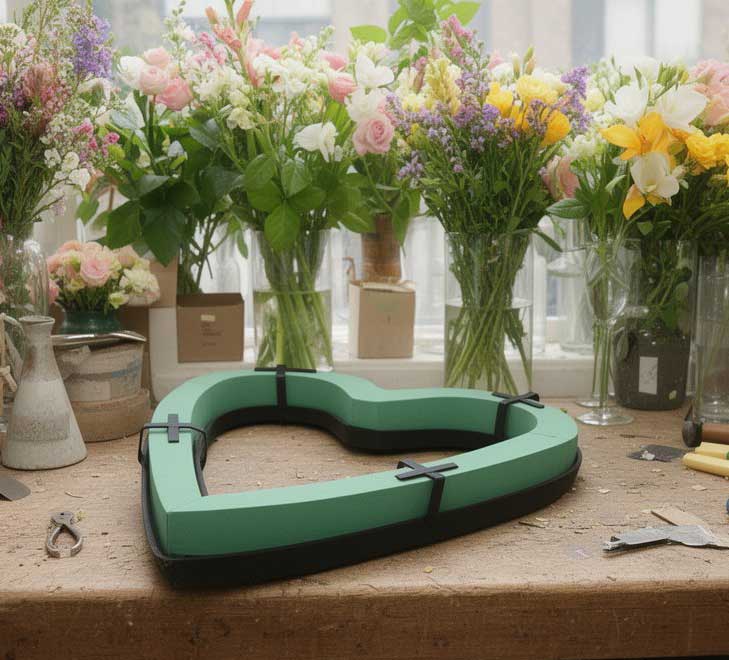
You can cut floral foam into any shape you need with a sharp knife, and honestly, that flexibility is one of its best features. But Oasis® also sells pre-formed shapes that save real time: cones, spheres, crosses, hearts, garlands, rounds, and more.
Some of these come with plastic or papier-mâché backing to prevent water leakage. Others come caged — like the Floracage® and Corso® holders — which are especially useful for sympathy work. The complete line of bouquet holders uses a caged foam design, too.
In my shop, I buy pre-made shapes for the holiday season and sympathy work when volume is high and time is short. For custom or creative arrangements, I cut my own.
Both approaches are valid. It just depends on what you’re making and how much time you have.
Tape It or Glue It — Here’s What I Actually Do
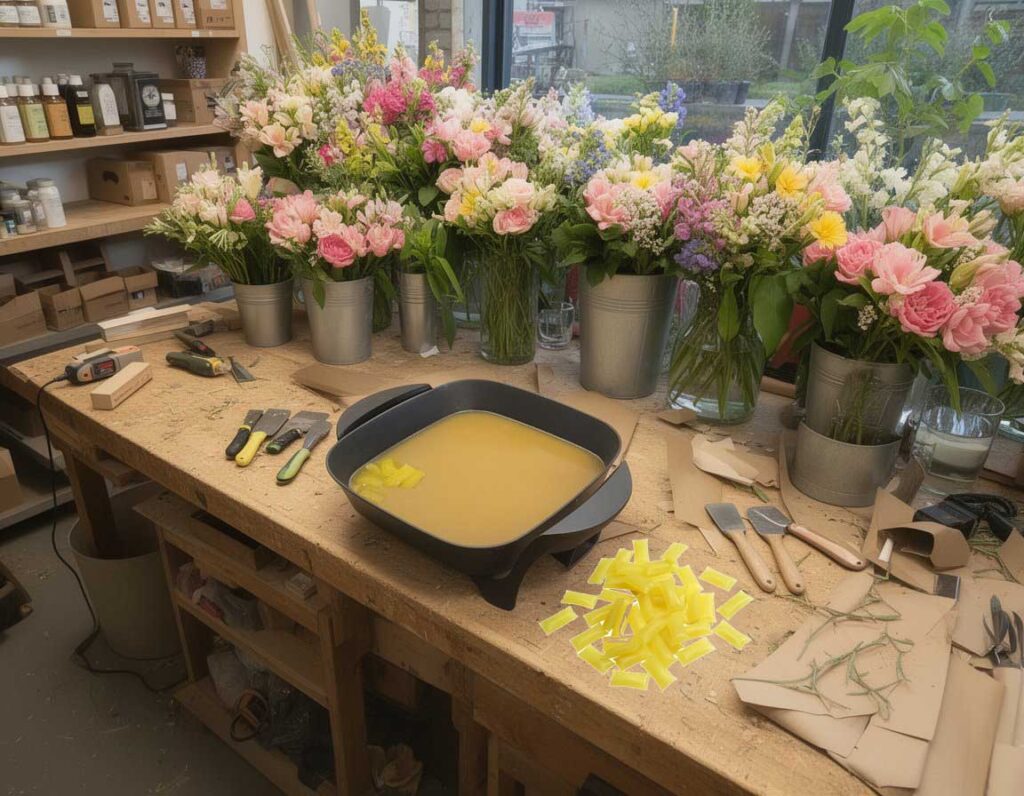
Before you begin your design, you need to secure your pre-soaked floral foam in the container using:
Waterproof Floral Tape
Oasis® makes its own waterproof tape, but I prefer Atlantic waterproof floral tape. It’s been around longer and, in my experience, has better adhesion. Either one works – It’s just a personal preference.
Hot Melt Pan Glue (My Preferred Method)
Here’s what I do most of the time, and what I recommend if you’re doing volume work or need a really secure hold: glue a block of dry foam into the container before soaking it.
Apply your hot melt pan glue, press the dry foam in, let it cool completely, then submerge the whole container in water to soak the foam. It sounds counterintuitive, gluing first, soaking second, but it works beautifully. The foam soaks right through the container, and the bond is stronger than tape.
It’s also easier to hide your mechanics this way. The tape sits on top and sometimes shows. Glue is invisible.
I prefer gluing over taping and use it most of the time. It’s cost-effective with cleaner results.
If you want the full rundown on picking the right glue for foam work specifically, I put together a separate guide: Best Floral Glue for Fresh Flowers and Foam.
Soak It Correctly — This Is Where Most Beginners Go Wrong
This is the step that seems simple and isn’t.
Fill a container, we use an ordinary dishpan at the shop, with clean water. Add floral preservative according to the directions. We use liquid Floralife, but the powdered variety works fine too.
Place the foam block on top of the water. Let it pull the water in on its own.
Do not push it underwater. Do not force it.
I can’t tell you how many beginners make this mistake. When you force the foam underwater, you trap air in the center of the block. That air pocket prevents water from reaching your flower stems — which means your arrangement dehydrates from the inside out, and you won’t know it until your flowers start drooping hours later.
Let the foam sink on its own. It takes a few minutes. It’s worth the wait.
Heading into a big project? Foam bricks are bulky and easy to run short on, and nobody wants to haul them home from the store. Prime can deliver eligible orders to your door, and eligible new members can start a free Prime trial. As an affiliate, we earn on qualifying purchases.
Floralife Flower Food on Amazon — add this to your soaking water. It makes a measurable difference in how long your flowers last.
Foam soaking is only one piece of getting flowers ready to arrange. If you want the full processing sequence — cutting, hydrating, conditioning — start to finish, I cover it here: How to Process Fresh Flowers Like a Pro.
The Eco Question — Let’s Be Honest About This
I want to talk about something the original version of this article didn’t address, because it’s become a real conversation in the industry.
Traditional floral foam is not biodegradable. It’s made from petroleum-based plastic, and when it breaks down, it breaks down into microplastics. Those microplastics get into water and soil. The UK’s Royal Horticultural Society no longer allows it at their major flower shows. The Slow Flowers Society in the US advocates for alternatives. This is a legitimate concern, and I think florists owe it to themselves to be informed.
That said, I’m not going to pretend there’s a perfect drop-in replacement that performs identically to Oasis®. There isn’t one — or there wasn’t, until very recently.
Here’s the news I’m genuinely excited about: in January 2025, Smithers-Oasis launched OASIS® Renewal™ Floral Foam, their new plant-based foam.
It earned a 4-star OK biobased certification from TÜV Austria, which is the highest rating available. They’re also claiming a carbon footprint that’s 56% lower than that of their petroleum-based foams.
What makes this one different from previous eco attempts is the performance claim. Oasis® specifically said they weren’t willing to release a product until it matched the look, feel, and performance florists already trusted.
And the density is designed as a true “one foam fits all”, meaning it’s supposed to work for delicate stems and heavy tropical stems alike, without needing to stock multiple densities.
I haven’t had it in the shop long enough to give you my full verdict. But Smithers-Oasis, which invented floral foam in 1954, knows what florists actually need. If any company was going to crack this, it was them. I’d encourage you to try it.
One practical note: it’s grey-green when dry and turns deep black when saturated. That black color is actually a feature; dark foam means you need about 25% fewer stems to achieve the same visual coverage, which matters to your budget.
OASIS® Renewal™ Floral Foam Available on Amazon
Here’s a quick rundown of the other alternatives worth knowing about:
Oasis® TerraBrick™
Their earlier plant-based option, made from coir and a compostable binder, is certified home and industrially compostable. Available now from wholesale floral suppliers. It’s a solid entry point if you want to start reducing your footprint today.
OshunPouch®
Made from 100% organic coco coir, home-compostable in about six months. Ships dry and expands when hydrated. Works well for most arrangements; for delicate stems like tulips or ranunculus, pre-drill a small hole first. Available at New Age Floral
Sideau / Agra-Wool
Made from spun basalt rock fibers and a plant-based binder. It’s fully biodegradable and compostable. Performs well for hydration. Honestly, stems don’t go in quite as smoothly as foam, and in large installations, it can get tricky. But it’s legitimately compostable. Available on Amazon
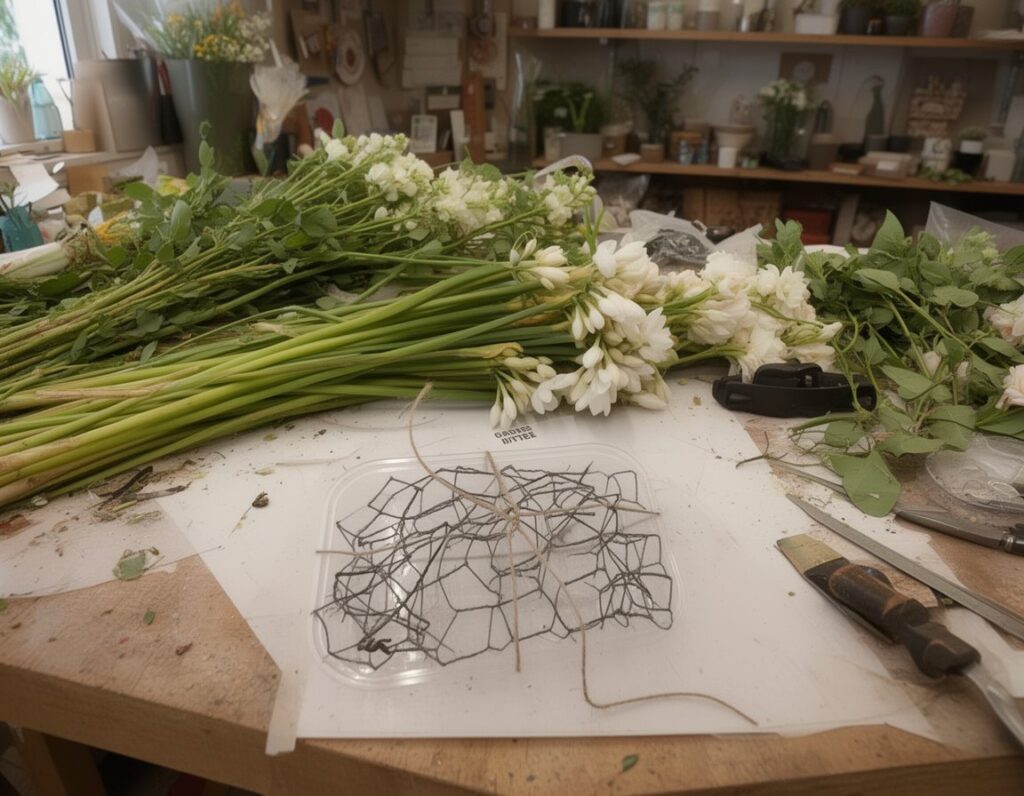
Chicken Wire + Waterproof Tape Grid
Old-school, zero-waste, completely reusable. Takes more skill than foam to get stems exactly where you want them. I use this for straight-to-water arrangements where it’s practical.
Pin Frogs (Kenzan)
Weighted metal or ceramic devices with pins. Reusable essentially forever. Great for ikebana-style work and compact arrangements. Not practical for large, complex pieces, but for what they’re designed for, they’re excellent. Available on Amazon
My honest take: I still use Oasis® in the shop for most commercial work because clients depend on reliable results. But for personal projects and for students learning the craft, I’ve started working with alternatives more often. Renewal is the easiest place to start if you want to make a change without upending your whole workflow.
If you’d rather skip foam altogether and see how a traditional arrangement comes together without it, I walked through one step by step here: Eco-Friendly Floral Design: A Traditional Front-Facing Arrangement Without Foam.
How to Soak and Prepare — Step by Step
- Fill a dishpan or large bucket with clean, cool water
- Add floral preservative per the package directions
- Set the foam block gently on top of the water
- Wait. Do not push it down. Let it absorb water at its own pace (2–4 minutes for standard foam, slightly longer for Deluxe)
- When the foam has fully sunk and feels uniformly heavy, it’s ready
- Transfer it immediately to your prepped container — either taped or glued in place
- Keep adding water to the container daily; foam needs to stay saturated to keep your flowers alive
That’s it. Simple when you know the rules.
What You’ll Need — Shopping List
| Item | My Pick |
|---|---|
| Everyday floral foam | Oasis® Instant Bricks |
| Delicate stems (tulips, iris, calla lilies) | Oasis® Springtime Foam |
| Large/tropical stems, weddings, events | Oasis® Deluxe Foam |
| Best new eco option (one foam fits all) | OASIS® Renewal™ |
| Eco alternative | Oasis® TerraBrick™ |
| Waterproof tape | Waterproof Floral Tape |
| Floral preservative | Floralife Flower Food |
| Hot Melt Pan glue | Hot Melt Pan Glue |
Frequently Asked Questions
What is the best brand of floral foam?
Oasis® is the industry standard and, in my opinion, still the best. I’ve tried generic and private-label alternatives, and they consistently underperform. The cost savings aren’t worth it on work that matters.
What’s the difference between Oasis® densities?
Springtime (light) is for soft-stemmed, delicate flowers like tulips and irises. Standard/Instant is for most everyday arrangements and flower types. Deluxe (high-density) is for heavy, woody, or tropical stems and large-scale event work.
Why should I never push floral foam underwater to soak it?
Pushing it down traps an air pocket in the center of the block. That air prevents water from reaching your stems, and your flowers will dehydrate even though the foam looks saturated from the outside. Always let it sink naturally.
Is floral foam bad for the environment?
Traditional phenolic floral foam is made from petroleum-based plastic and breaks down into microplastics. It’s a legitimate environmental concern. The most exciting development right now is OASIS® Renewal™, launched in January 2025 — a plant-based foam from the original manufacturer with a carbon footprint 56% lower than traditional Oasis® and a 4-star OK biobased certification. Other alternatives include Oasis® TerraBrick™, OshunPouch®, and Sideau (Agra-Wool), each with different performance trade-offs.
Can I reuse floral foam?
Traditional foam can technically be reused once if it hasn’t dried out completely, but stem holes weaken the structure. Most florists treat it as single-use. Eco alternatives like OshunPouch® are specifically designed for reuse.
Should I tape or glue floral foam into my container?
Both work. I prefer gluing dry foam into the container first, then soaking the whole thing. It gives a stronger hold, hides the mechanics better, and is more cost-effective for volume work.
What’s the best floral preservative to add to the soaking water?
We use liquid Floralife in the shop. The powdered version works just as well. Adding floral preservatives to your soaking water meaningfully extends how long your flowers stay fresh in the arrangement.
Do I need different foam for a sympathy tribute versus a table centerpiece?
Probably. For a sympathy tribute with large or heavy stems, I’d use Deluxe. For a standard table centerpiece with mixed flowers, Instant Oasis® handles it well. When in doubt, think about the heaviest stem you’re inserting. That tells you which density to reach for.
Once you’ve got a properly soaked block of foam secured in a clean container, something shifts. Suddenly you’re not fighting your arrangement — you’re building it.
Stems go exactly where you want them. The design holds. The flowers stay hydrated. Everything blooms the way it should.
That’s the foundation this craft is built on, and whether you get there with tape or glue, the results speak for themselves. I’ve made my case for glue. Where do you land? Let me know in the comments below.
Til next time,